

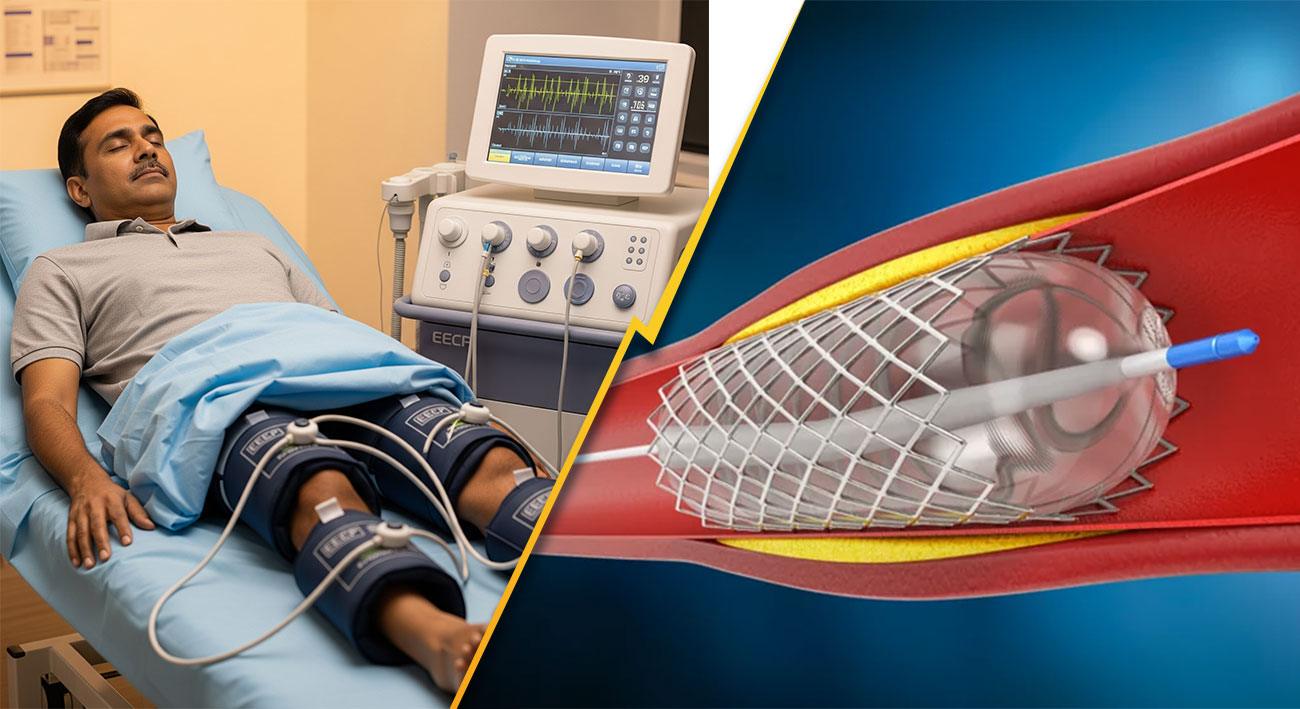
When faced with the debilitating symptoms of angina, the chest pain and pressure caused by blocked coronary arteries patients and their doctors arrive at a critical crossroads. The conventional path often leads to an invasive procedure like angioplasty, a mechanical fix designed to physically open a blockage. However, a growing body of evidence supports a powerful, non-invasive angina treatment known as Enhanced External Counterpulsation (EECP).
The debate of EECP vs angioplasty is not merely about different techniques; it represents a fundamental choice between a localized, invasive intervention and a non-surgical, systemic therapy that empowers the body’s own healing mechanisms. This report provides a comprehensive comparison to help patients understand the risks, benefits, and ideal scenarios for each approach.
Percutaneous Coronary Intervention (PCI), commonly known as angioplasty, is a procedure used to open clogged heart arteries. During the procedure, a cardiologist threads a thin tube (catheter) through a blood vessel in the arm or groin up to the heart. Using X-ray guidance, a tiny balloon at the catheter’s tip is inflated at the site of the blockage, compressing the fatty plaque against the artery wall to restore blood flow. In the vast majority of cases, a small, metal mesh tube called a stent is then deployed to prop the artery open permanently.
Angioplasty is a cornerstone of emergency cardiac care, proving highly effective at stopping a heart attack in progress by rapidly restoring blood flow. However, for patients with stable angina, its role and limitations are more complex. While it provides an immediate mechanical solution to a specific blockage, angioplasty does not cure the underlying condition of coronary artery disease. This distinction gives rise to several significant limitations.
The most prominent limitation is in-stent restenosis (ISR), where the treated artery begins to narrow again inside or around the stent. Despite advances like drug-eluting stents, which release medication to prevent scar tissue, ISR remains a challenge, with rates between 5% and 15%. This often leads to the return of angina and the need for repeat interventions, which carry their own escalating risks. Another serious concern is stent thrombosis, where blood clots form within the stent, potentially causing a heart attack. This risk necessitates long-term treatment with potent blood-thinning medications, which themselves can increase the risk of bleeding.
Furthermore, as an invasive procedure, angioplasty carries inherent angioplasty risks, including bleeding or bruising at the catheter insertion site, allergic reactions to the contrast dye, and, in rare cases, more severe complications like damage to the coronary artery, kidney injury, stroke, or heart attack during the procedure itself. The
recovery period typically involves at least an overnight hospital stay and restrictions on strenuous activity for a week or more.
In stark contrast to the invasive nature of angioplasty, Enhanced External Counterpulsation (EECP) therapy is a completely non-invasive, outpatient treatment that improves heart health without surgery or hospitalization. During a session, a patient rests comfortably on a treatment bed while large cuffs, similar to blood pressure cuffs, are wrapped around their legs and buttocks. These cuffs inflate and deflate in precise synchronization with the patient’s heartbeat, monitored by an EKG.
The cuffs inflate sequentially from the calves up to the thighs at the start of diastole (the heart’s resting phase). This action gently squeezes blood from the lower body back toward the heart, a process called diastolic augmentation. This is critically important because it increases blood flow and oxygen supply to the heart muscle itself, which receives the majority of its blood during this resting period. Just before the heart contracts to pump blood, the cuffs rapidly deflate, creating a vacuum effect that reduces the heart’s workload.
The true power of this non-invasive angina treatment lies in its ability to stimulate the body’s own healing processes. The repeated increase in blood flow during the full course of therapy promotes the formation of new blood vessels, a process called angiogenesis. These new vessels form a network of natural bypasses that circumvent blocked arteries, creating durable new pathways for blood to reach the heart muscle. This makes EECP an excellent
stent alternative that addresses the entire circulatory system of the heart, rather than just a single blockage. The standard treatment involves one-hour sessions, typically administered five days a week for seven weeks, with no downtime or recovery period required after each session.

When comparing EECP vs PCI (Percutaneous Coronary Intervention), the differences in safety, effectiveness, and long-term outcomes are striking.
Feature | EECP Therapy | Angioplasty (PCI) with Stenting |
Procedure Type | Completely non-invasive; external cuffs on legs | Invasive; catheter inserted into an arter |
Primary Risks | Minimal. Most common are minor skin irritation, bruising, or muscle aches. Rare risk of shortness of breath. | Bleeding, infection, blood clots, re-narrowing of the artery (restenosis). Rare but serious risks include heart attack, stroke, and artery damage. |
Efficacy for Stable Angina | Reduces angina frequency, improves exercise tolerance, and enhances quality of life. Benefits can last for years. 5-year survival rate of 88% is comparable to or better than PCI. | Provides immediate symptom relief by opening a specific blockage. However, for stable patients, major clinical trials (COURAGE, ISCHEMIA) showed it does not reduce the long-term risk of heart attack or death over medical therapy alone. |
Repeat Interventions | Benefits can be sustained for up to 5 years. A repeat course is safe and effective if symptoms return. The repeat procedure rate is about 18-20% at two years. | High rates of in-stent restenosis (5-15%) often require repeat interventions. Repeat PCI for restenosis is associated with worse outcomes than the initial procedure. |
Recovery | No recovery time needed. Patients can resume normal activities immediately after each one-hour outpatient session. | Requires hospital stay (usually overnight) and restricted activity for at least a week. |
A head-to-head comparison study found that while PCI resulted in a higher percentage of patients being completely free of angina at one year, the rates of major adverse events (like death or subsequent bypass surgery) and overall survival were comparable between the two groups. This suggests that for stable patients, EECP offers a similar level of long-term safety with far less procedural risk.
For patients actively having a heart attack or suffering from unstable angina, angioplasty is a life-saving emergency procedure designed to rapidly restore blood flow and limit heart damage. EECP is not an emergency treatment.
This is the largest group who can benefit. For individuals whose symptoms occur predictably with exertion but who are not in an emergency state, EECP offers a way to manage symptoms and improve heart function without the risks of an invasive procedure.
Many individuals are not suitable candidates for angioplasty or bypass surgery due to other health issues (co-morbidities), unfavorable artery anatomy, or because they are considered too high-risk for surgical complications. For these patients, EECP is a safe and effective lifeline.
It is common for angina to return months or years after an angioplasty or even bypass surgery. EECP is an excellent option for these patients, as it works through a different mechanism to improve blood flow without performing another invasive procedure.
For individuals seeking to avoid the risks, recovery time, and potential complications of an invasive procedure, EECP provides a proven, non-surgical path to symptom management.

Perhaps the most crucial distinction is that angioplasty is a localized, mechanical repair, whereas EECP is a systemic, physiological therapy. Angioplasty fixes a single plumbing problem in one artery, but it does not address the widespread nature of coronary artery disease.
EECP, when combined with optimal medical therapy and lifestyle changes, tackles the root cause of the issue. It improves the health of the entire vascular system by enhancing endothelial function (the health of the artery lining), reducing inflammation, and stimulating the growth of a natural collateral network to improve blood flow throughout the heart. This holistic approach offers a more comprehensive strategy for long-term heart health. For stable patients, landmark clinical trials have shown that optimal medical therapy (which can include EECP) provides similar long-term outcomes in preventing heart attack and death as invasive stenting, underscoring the power of a non-invasive approach.
Ultimately, the decision between EECP and angioplasty should be a thoughtful conversation between a patient and their cardiologist. For a cardiac emergency, angioplasty is the undisputed standard of care. But for the millions of patients living with chronic, stable angina, EECP presents a safe, effective, and non-invasive treatment that not only relieves symptoms but also improves the heart’s overall function for a healthier future.
Discover recipes that blend taste with health, crafted by our experts for your well-being.

Discover groundbreaking diagnostic services exclusive to India, now available at Arka Health, Bangalore