
Natural Cycle IVF: Who Is (and Isn’t) a Good Candidate

Reviewed by Dr. Saraswathi Ramesh
M.B.B.S., M.D. (OBG), FMIS-Gynaecology
Fellowship in Urogynaecology, 35+ years' experience.
Executive Summary
The landscape of Assisted Reproductive Technology (ART) is currently undergoing a significant paradigm shift. For decades, the prevailing orthodoxy has favored “Controlled Ovarian Hyperstimulation” (COH)—a maximalist approach relying on high doses of exogenous gonadotropins to recruit large cohorts of oocytes. While effective for many, this industrial approach to reproduction is increasingly scrutinized for its physiological toll, financial burden, and potential to compromise oocyte quality in specific patient demographics. In this context, Natural Cycle In Vitro Fertilization (NC-IVF) has re-emerged not merely as a historical footnote, but as a sophisticated, physiology-first intervention. This report provides an exhaustive clinical analysis of NC-IVF, specifically tailored for the patient population and clinical philosophy of ARKA Anugraha Hospital.
ARKA Anugraha, with its flagship presence in JP Nagar, Bangalore, and its “Arka Revitalize” satellite in Mysore, stands at a unique intersection of advanced surgical intervention and holistic, functional medicine. Under the leadership of specialists like Dr. Gaurang Ramesh, who bridges the gap between surgical gastroenterology and functional medicine, the hospital is uniquely positioned to champion a fertility model that prioritizes systemic health—specifically the gut-reproductive axis—over brute-force hormonal stimulation.
This report dissects the biological mechanisms of Natural Cycle IVF, contrasting it with Conventional and Minimal Stimulation protocols. It identifies the “Good Candidate” through a nuanced lens, moving beyond simple age-based metrics to include ovarian reserve markers, previous stimulation failures, and specific medical contraindications like estrogen-sensitive malignancies. Conversely, it rigorously delineates the “Poor Candidate,” providing clinicians and patients with clear exclusion criteria to prevent futile treatment cycles. Furthermore, we explore the operational and financial dimensions of implementing NC-IVF in the Indian market, comparing the cost-effectiveness of this low-drug approach against the high-capital requirements of standard IVF. By integrating data on success rates, implantation dynamics, and the emerging science of the microbiome’s role in fertility, this document serves as a foundational roadmap for ARKA Anugraha to outrank competitors like Santasa and Dr. Jyothi’s Fertility Centre by offering a more personalized, scientifically grounded, and holistic path to parenthood.
1. The Biological Rationale: Physiology of the Natural Cycle
To understand the clinical utility of Natural Cycle IVF, one must first appreciate the exquisite complexity of spontaneous human folliculogenesis. Conventional IVF operates on a mechanism of “rescue,” utilizing high doses of Follicle Stimulating Hormone (FSH) to save a cohort of antral follicles that were destined for atresia (programmed cell death). However, this rescue operation is not without biological cost.
1.1 The Concept of the “Golden Egg” vs. Cohort Recruitment
In a spontaneous menstrual cycle, the female body engages in a rigorous selection process. From a pool of developing antral follicles, a complex interplay of endocrine feedback loops ensures that typically only one follicle—the dominant follicle—reaches maturity. This selection is driven by the inter-cycle rise in FSH, followed by its suppression via Inhibin B and Estradiol secreted by the growing follicle.
The central hypothesis supporting Natural Cycle IVF is that this naturally selected dominant follicle contains the oocyte with the highest biological competence. It is the “Golden Egg” that the body has prioritized. In contrast, Controlled Ovarian Stimulation forces the growth of subordinate follicles. While this increases the quantity of eggs available for retrieval, evidence suggests it may not linearly increase the quality. In older women or poor responders, the additional eggs recruited by high-dose medication are often aneuploid (chromosomally abnormal) or cytoplasmically immature, offering no real advantage over the single dominant follicle while significantly increasing the metabolic and financial stress on the patient.
1.2 Endometrial Receptivity and Hormonal Milieu
A critical and often overlooked advantage of Natural Cycle IVF lies in the endometrial environment. During conventional IVF, the supraphysiological levels of estradiol—often reaching 2000–3000 pg/mL or more—can exert a deleterious effect on the endometrium. High estrogen levels can advance the histological maturation of the uterine lining, creating a window of implantation that is desynchronized from the embryo’s development. This phenomenon is a leading cause of implantation failure in fresh transfer cycles of stimulated IVF.
Natural Cycle IVF avoids this desynchronization entirely. Because the hormonal profile remains physiological, the endometrium develops in perfect concert with the follicle. The corpus luteum formed after retrieval is of higher functional quality compared to the luteinized cysts seen in stimulated cycles, potentially requiring less intensive luteal phase support. For ARKA Anugraha, which emphasizes holistic health, this preservation of the body’s natural hormonal rhythm aligns perfectly with functional medicine principles, minimizing the disruption to the hypothalamic-pituitary-ovarian (HPO) axis.
1.3 The Mechanism of Oocyte Retrieval in Natural Cycles
The procedural biology of retrieving a single egg differs fundamentally from harvesting fifteen. In a natural cycle, the timing is unforgiving. The spontaneous Luteinizing Hormone (LH) surge can occur at any time once the follicle exceeds 16mm, triggering ovulation within 36-40 hours. If the retrieval is not perfectly timed, the egg is lost to the abdominal cavity.
To mitigate this, modern protocols often utilize the Modified Natural Cycle (MNC-IVF). In this protocol, the patient is monitored until the dominant follicle reaches 14-17mm. At this critical juncture, a GnRH antagonist may be introduced to block the body’s spontaneous LH surge, followed immediately by an exogenous trigger (hCG or GnRH agonist) to induce final oocyte maturation. This “modification” allows the clinician to schedule the retrieval during working hours while maintaining the drug-free benefits of the growth phase. This precision requires high-frequency monitoring, a service that ARKA Anugraha’s dedicated team and advanced laboratory infrastructure are well-equipped to provide.
2. Clinical Candidates: Who Is a "Good" Candidate?

The ideal candidate for Natural Cycle IVF is not necessarily the patient with the best prognosis, but rather the patient for whom the marginal benefit of stimulation is zero or negative. At ARKA Anugraha, identifying these patients requires a shift from volume-based metrics to personalized physiological assessment.
2.1 Women with Diminished Ovarian Reserve (DOR)
The most robust indication for Natural Cycle IVF is Diminished Ovarian Reserve, characterized by low Anti-Müllerian Hormone (AMH) levels (<0.5-1.0 ng/mL) and elevated basal FSH (>10 IU/L).
- Physiological Rationale: In patients with severe DOR, the ovarian reserve is so depleted that the recruitment cohort is virtually non-existent. Administering maximal doses of gonadotropins (e.g., 300-450 IU of FSH daily) often results in the growth of the same one or two follicles that would have grown naturally. The ovaries simply cannot produce eggs that are not there.
- Clinical Implication: For these women, conventional IVF represents a financial and emotional drain with no yield advantage. NC-IVF offers a rational alternative: retrieving the single available egg without the ₹50,000–₹100,000 cost of medications per cycle. It shifts the focus from “trying to get more” to “optimizing the one we have.”
2.2 Poor Responders to Conventional Stimulation
A distinct but related category is the “Poor Responder.” These are women who may have normal or borderline ovarian reserve markers but, for unknown reasons, fail to respond to stimulation (producing <3 follicles).
- The “Gonadotropin Resistance” Factor: Some ovaries possess follicle FSH receptors that are insensitive to exogenous stimulation. Continuing to bombard these receptors with synthetic hormones is futile.
- Strategic Pivot: By pivoting to NC-IVF, clinicians at ARKA Anugraha can bypass this resistance mechanism, relying instead on the endogenous FSH rise which may be more biologically potent or effective at the receptor level for that specific patient.
2.3 Women of Advanced Reproductive Age (Over 40)
Age is the single most significant factor affecting IVF success. In women over 40, and certainly over 42, the primary hurdle is oocyte quality (aneuploidy), not just quantity.
- The Aneuploidy Challenge: High-dose stimulation does not correct chromosomal errors; in fact, some oxidative stress theories suggest it might exacerbate them in fragile, aged oocytes.
- The “Banking” Strategy: NC-IVF allows for a strategy of accumulation. Because the procedure is less invasive and cheaper, a 42-year-old patient can undergo 3–4 consecutive natural cycles to bank embryos. This “slow and steady” approach is often more psychologically sustainable than a single, high-stakes failed stimulated cycle.
2.4 Patients at Risk of Ovarian Hyperstimulation Syndrome (OHSS)
While typically associated with high responders, women with Polycystic Ovary Syndrome (PCOS) are at varying risks. For those who have experienced severe, life-threatening OHSS in previous cycles, the fear of recurrence is a major barrier to care.
- Absolute Safety: Natural Cycle IVF is the only protocol that carries a effectively zero risk of OHSS.17 Since there is no multi-follicular development and no heavy luteinization of multiple corpora lutea, the vascular permeability factors (like VEGF) that drive OHSS are not elevated. For patients prioritizing safety above all, this is the definitive choice.
2.5 The Holistic and “Chemical-Free” Patient
A growing demographic of patients, particularly those attracted to integrative centers like ARKA Anugraha, actively seeks to minimize synthetic chemical exposure.
- Cancer Survivors: Women with a history of estrogen-receptor-positive breast cancer often cannot safely undergo hyperstimulation due to the astronomical estradiol levels it generates. NC-IVF keeps estradiol within physiological ranges, making it a safer fertility preservation or reproductive option under oncological guidance.
- Lifestyle alignment: Patients who adhere to organic lifestyles, functional medicine protocols, or have high anxiety regarding medical interventions (needle phobia) find NC-IVF align with their values. The protocol is “injection-free” or “injection-light,” dramatically reducing the medicalization of the process.
2.6 Ethical and Religious Considerations
Certain religious or ethical frameworks object to the creation of supernumerary embryos that may be discarded or frozen indefinitely. NC-IVF typically produces one egg and one embryo, offering a “one-to-one” creation-to-transfer ratio that resolves these ethical conflicts for devout couples.
3. Contraindications: Who Is a "Poor" Candidate?
While the philosophy of Natural Cycle IVF is appealing, indiscriminate application can lead to low success rates and patient attrition. It is vital for ARKA Anugraha to enforce strict exclusion criteria.
3.1 Anovulatory Disorders (Severe PCOS)
The fundamental prerequisite for Natural Cycle IVF is a natural cycle.
- Mechanism Failure: Women with WHO Group II anovulation (e.g., classic PCOS with amenorrhea) do not recruit a dominant follicle spontaneously. Without a follicle to track, NC-IVF is impossible.
- The Distinction: These patients are better candidates for Minimal Stimulation (Mini-IVF) or ovulation induction using oral agents like Letrozole or Clomid. This induces ovulation without the risks of full blown IVF, bridging the gap effectively.
3.2 Requirement for Preimplantation Genetic Testing (PGT)
For couples carrying monogenic genetic disorders (e.g., Thalassemia, Cystic Fibrosis) or older couples insisting on PGT-A for aneuploidy screening, NC-IVF presents a logistical hurdle.
- Logistical Inefficiency: PGT requires a trophoblast biopsy from a blastocyst. Biopsying a single embryo is technically feasible but cost-inefficient (biopsy fees + genetic lab fees are high per run). Furthermore, many natural cycle embryos are transferred on Day 2 or 3, reaching the uterus before the blastocyst stage required for biopsy.
- Workaround: PGT is only viable with NC-IVF if the patient is willing to batch (freeze) embryos from multiple cycles and biopsy them simultaneously, significantly extending the time-to-diagnosis.
3.3 Severe Male Factor Infertility
In cases of severe oligoasthenoteratozoospermia (OATS) or non-obstructive azoospermia requiring surgical sperm retrieval (TESA/PESA), the margin for error is nonexistent.
- Fertilization Risk: Fertilization rates with ICSI are typically 70–80%. With only one egg, there is a statistically significant risk (20–30%) of total fertilization failure. In conventional IVF with 10 eggs, a few failures are acceptable; in NC-IVF, it results in cycle cancellation.
- Sperm Vitality: If sperm is surgically retrieved, it is precious and limited. Wasting a surgical sample on a single egg is clinically imprudent.
3.4 Tubal Factor Infertility with Good Reserve
For a young woman (e.g., 30 years old) with blocked fallopian tubes but excellent ovarian reserve, the machinery of the ovary is intact; only the transport is broken.
Efficiency Loss: This patient could easily produce 15 high-quality eggs in a single stimulated cycle, potentially yielding enough embryos for 2 or 3 children (complete family building). Restricting her to NC-IVF would be a disservice, subjecting her to months of repeated procedures to achieve what could be done in two weeks.
4. The Clinical Procedure at ARKA Anugraha: A Step-by-Step Protocol
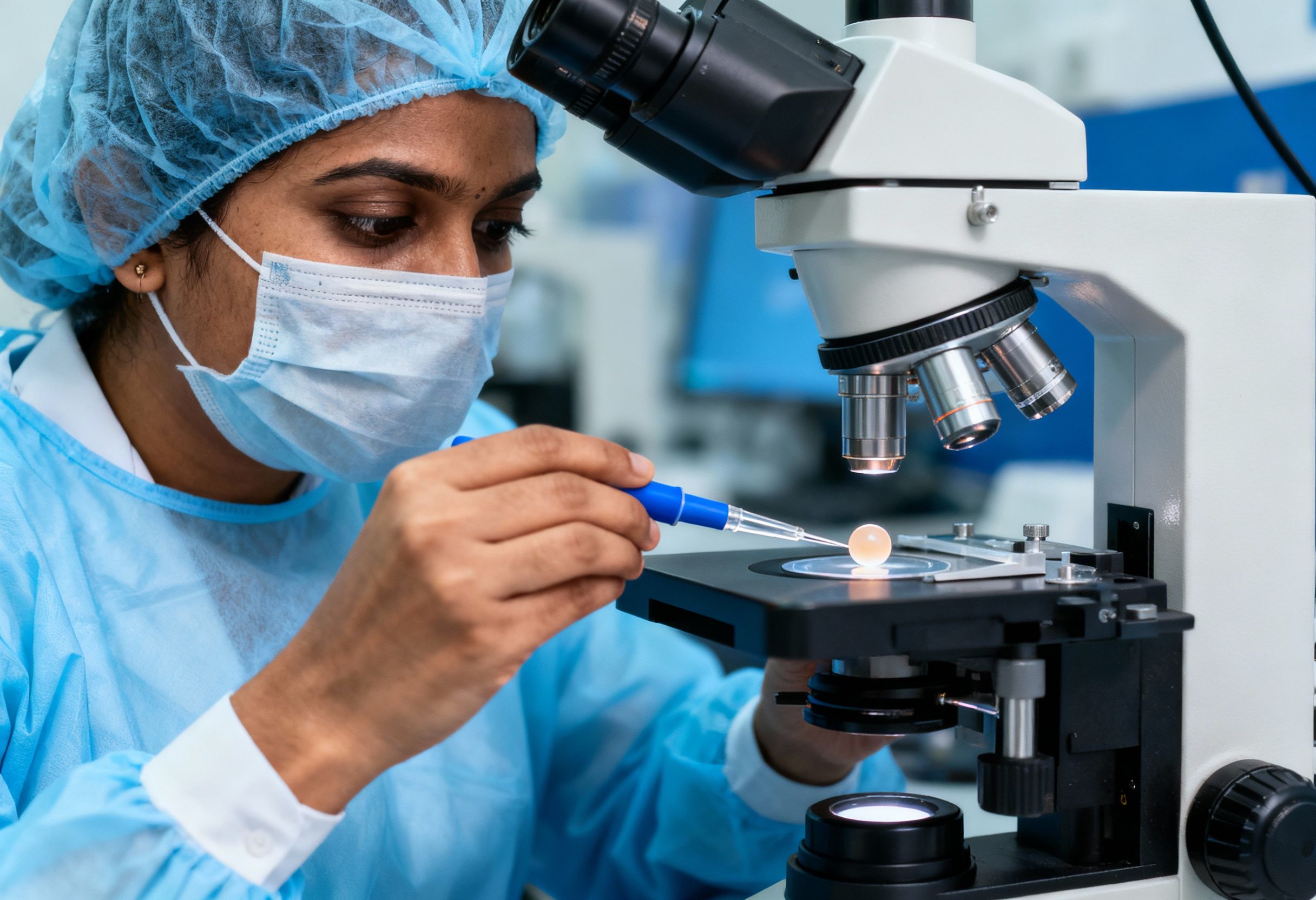
The operational workflow of Natural Cycle IVF differs markedly from conventional IVF. It shifts the burden from the pharmacy to the monitoring room. For ARKA Anugraha, this requires a responsive and agile clinical team.
4.1 Phase 1: High-Frequency Monitoring
Unlike stimulated cycles where the clinician “drives” the growth, in NC-IVF, the clinician “passengers” the natural growth.
- Baseline Assessment (Day 2-3): Transvaginal ultrasound and serum hormone assays (FSH, LH, E2, P4) confirm the absence of cysts and establish the start of the cycle.
- Follicular Tracking (Day 8 onwards): Once the dominant follicle is identified (>10mm), monitoring frequency increases. By the time the follicle reaches 14mm, daily ultrasounds and LH blood tests are often necessary to detect the onset of the spontaneous LH surge.
- The Challenge of “Premature Ovulation”: The risk of the follicle rupturing before retrieval is the primary cause of cycle cancellation in pure natural cycles (reported up to 30% in some literature). This necessitates the Modified Natural Cycle approach used by top clinics.
4.2 Phase 2: Triggering and Timing (The Modified Protocol)
To control the uncontrollable, the Modified Natural Cycle (MNC) utilizes a pharmacological trigger.
- The Decision Point: When the lead follicle reaches 16–18mm and Estradiol is >150–200 pg/mL per follicle, a trigger is administered.
- The Agent: A GnRH antagonist (e.g., Cetrotide) may be given to prevent immediate ovulation, followed by hCG (Human Chorionic Gonadotropin) or a GnRH agonist trigger.
- The Clock: Egg retrieval is strictly scheduled 34–36 hours post-trigger.27 This precision allows ARKA Anugraha to schedule the procedure during operational hours, improving staffing efficiency.
4.3 Phase 3: Oocyte Retrieval – The Anesthesia Advantage
A critical differentiator for NC-IVF is the retrieval experience.
- Minimally Invasive: Conventional retrieval involves 10–20 vaginal punctures to access both ovaries. NC-IVF involves a single puncture into the single dominant follicle.
- Anesthesia Protocol: Because the procedure is so rapid (often <5 minutes) and involves minimal trauma, general anesthesia is rarely required.
- Local Anesthesia: Paracervical block or simple local infiltration is often sufficient.
- Conscious Sedation: Mild sedation (IV midazolam/fentanyl) ensures comfort without the risks and recovery time of Propofol-based deep sedation.
- Patient Experience: Patients can often walk out of the clinic within 30 minutes, avoiding the grogginess and nausea associated with full anesthesia. This “lunch-break IVF” appeal is significant for working professionals in Bangalore’s tech hubs.
4.4 Phase 4: The Laboratory Phase – High-Stakes Embryology
In NC-IVF, the embryology laboratory is the crucible. With only one egg, there is no margin for error.
- Infrastructure: ARKA Anugraha’s facility boasts a Class 10,000 lab environment with a centralized Air Handling Unit (AHU) featuring 5-stage filtration and 0.3-micron HEPA filters.12 This purity is essential; single eggs are more vulnerable to volatile organic compounds (VOCs) and environmental stress than a large cohort.
- ICSI Application: Intracytoplasmic Sperm Injection (ICSI) is frequently employed even in non-male factor cases to ensure fertilization occurs. The risk of failed fertilization in standard IVF insemination (where sperm and egg are mixed in a dish) is too high a gamble for a single-oocyte cycle.
- Assisted Hatching: Techniques like Laser Assisted Hatching (LAH) may be used to aid implantation, especially in older women with thickened zona pellucida, a service highlighted by regional competitors like Dr. Jyothi’s Fertility Centre and available at high-end labs.
4.5 Phase 5: Embryo Transfer
- Timing: Embryos are typically transferred on Day 2 (4-cell stage) or Day 3 (8-cell stage). Wait-listing for Day 5 (Blastocyst) is risky with a single embryo, as the culture environment is never as perfect as the uterus. “Put it back where it belongs” is the guiding maxim.
- Luteal Support: Unlike stimulated cycles where the corpus luteum function is deranged, natural cycles usually have a robust corpus luteum. Luteal support (Progesterone) is often minimal—vaginal suppositories rather than painful intramuscular oil injections.
5. Comparative Analysis: Natural vs. Mini vs. Conventional
To position NC-IVF correctly, it must be benchmarked against the alternatives.
Feature | Natural Cycle IVF (NC-IVF) | Minimal Stimulation (Mini-IVF) | Conventional IVF |
Primary Drug | None (or Trigger only) | Oral (Clomid/Letrozole) + Low FSH | Injectable Gonadotropins (High Dose) |
Target Egg Yield | 1 | 2 – 5 | 10 – 15+ |
OHSS Risk | Zero | Very Low (<1%) | Moderate to High (depending on protocol) |
Anesthesia | Local / None | Sedation / Local | Deep Sedation / General Anesthesia |
Estrogen Levels | Physiological (<300 pg/mL) | Mildly Elevated (<1000 pg/mL) | Supraphysiological (>2000 pg/mL) |
Cost (India) | Low (₹1.0L – ₹1.5L) | Moderate (₹1.5L – ₹2.0L) | High (₹2.0L – ₹3.0L+) |
Primary Candidate | DOR, Age >40, Holistic preference | PCOS, Poor Responders, Moderate DOR | Unexplained Infertility, Tubal Factor, Donor Egg |
The “Mini-IVF” Nuance:
It is crucial to distinguish NC-IVF from Mini-IVF. Mini-IVF (often popularized by protocols utilizing Clomiphene Citrate) stimulates the release of endogenous FSH from the pituitary. This is an excellent “middle ground” for patients who want more than one egg but want to avoid the cost and side effects of full IVF.3 For ARKA Anugraha’s PCOS patients, Mini-IVF using Letrozole is likely the superior protocol over pure NC-IVF, as it guarantees ovulation and yields a manageable cohort of 3–5 eggs without OHSS risk.
6. The ARKA Anugraha Advantage: Integrative Fertility

In the competitive fertility market of Karnataka, encompassing Bangalore and Mysore, technical competence is the baseline. The differentiator is the philosophy of care. ARKA Anugraha leverages a unique asset: the integration of high-tech embryology with functional medicine, specifically targeting the Gut-Reproductive Axis.
6.1 Dr. Gaurang Ramesh and the Gut-Fertility Connection
Dr. Gaurang Ramesh, a key figure at ARKA, brings a background in Surgical Gastroenterology and Functional Medicine that is rare in the fertility sector.
- The Microbiome Science: Emerging research posits that the gut microbiome regulates circulating estrogen levels via the secretion of an enzyme called beta-glucuronidase. This collection of bacteria is termed the “estrobolome.” Dysbiosis (imbalance) in the gut can lead to impaired estrogen metabolism, contributing to conditions like Endometriosis and PCOS, which directly impact fertility.
- Clinical Application: At ARKA, the preparation for Natural Cycle IVF likely goes beyond ultrasounds. It involves optimizing gut health to reduce systemic inflammation. A non-inflamed system is more likely to produce a high-quality dominant follicle and a receptive endometrium. This “Pre-Conception Optimization” is a service that purely mechanical IVF clinics often neglect.
6.2 The Bangalore-Mysore Ecosystem
ARKA Anugraha operates in a dual landscape.
- Bangalore (JP Nagar): The main hospital serves a cosmopolitan, tech-savvy population. Here, the appeal of NC-IVF is often “lifestyle-based”—avoiding the disruption of work, the side effects of hormones, and the “medicalization” of reproduction.
- Mysore (Arka Revitalize): The Mysore branch caters to a demographic that values personalized, approachable care. In Mysore, competitors like Santasa IVF and Dr. Jyothi’s Fertility Centre are well-established.
- Santasa emphasizes its “Class 10,000 IVF Lab” and affordability.
- Dr. Jyothi highlights technical innovations like Laser Assisted Hatching.
- ARKA’s Edge: ARKA differentiates itself by offering the Functional Medicine layer. While others focus on the lab tech (which ARKA also possesses 12), ARKA focuses on the patient’s biological terrain. The narrative is not just “we have a good lab,” but “we prepare your body to succeed.”
6.3 Infrastructure and Technology
ARKA’s commitment to quality is evidenced by its infrastructure. The use of India’s 1st Eurovent certified Hygiene AHU (manufactured by System Air, Switzerland) and antimicrobial wall cladding (Bioclad, UK) in the lab ensures that the single egg retrieved in a natural cycle is protected from even microscopic environmental insults. This technological rigor supports the biological fragility of Natural Cycle oocytes.
7. Financial and Ethical Dimensions in the Indian Context
In India, where insurance coverage for fertility is nascent, out-of-pocket cost is a primary determinant of access.
7.1 Cost-Effectiveness Analysis
The financial structure of NC-IVF is distinct.
Cost Head | Conventional IVF (INR) | Natural Cycle IVF (INR) | Notes |
Doctor/Procedure Fees | ₹1.5 Lakh – ₹2.0 Lakh | ₹1.0 Lakh – ₹1.5 Lakh | NC requires more monitoring visits but simpler retrieval. |
Stimulation Drugs | ₹50,000 – ₹1.0 Lakh | ₹0 – ₹5,000 | The primary saving driver. Only trigger shots needed. |
Anesthesia Charges | ₹5,000 – ₹10,000 | ₹0 – ₹2,000 | Local anesthesia avoids anesthetist fees. |
Freezing/Storage | ₹30,000+ (for surplus) | ₹0 (if fresh transfer) | No surplus embryos to freeze saves annual storage fees. |
Total Per Cycle | ₹2.3 Lakh – ₹3.5 Lakh | ₹1.0 Lakh – ₹1.6 Lakh | ~50% reduction in upfront cost. |
(Data synthesized from 15)
7.2 The Cumulative Cost Nuance
While cheaper per cycle, NC-IVF may be more expensive per live birth for young, good-prognosis patients who would otherwise succeed in one stimulated cycle. However, for a poor responder who might need 4 cycles regardless of protocol, paying ₹1.0 Lakh x 4 (₹4 Lakhs) is often more feasible and less physically taxing than paying ₹3.0 Lakh x 3 (₹9 Lakhs) for stimulated cycles that yield the same 1-2 eggs.
7.3 Ethical Embryo Disposal
A silent crisis in Indian fertility clinics is the accumulation of thousands of abandoned frozen embryos. Couples often struggle with the moral decision of what to do with surplus embryos once their family is complete. NC-IVF solves this ex ante. By creating only the embryos intended for transfer, it aligns with the values of couples who wish to avoid the ethical dilemma of disposal or donation.
8. Success Rates: Realistic Expectations
Transparency regarding success rates is critical to maintaining trust.
- Per-Cycle Success: Generally, NC-IVF has a lower success rate per started cycle (approx. 7–15%) compared to stimulated IVF (30–50%).4 This is largely due to the lack of backup embryos; if the one egg fails to fertilize, the cycle ends.
- Cumulative Success: However, cumulative pregnancy rates after 3–4 natural cycles can approach those of conventional IVF, particularly in older women.
- Indian Data: For women under 35, success rates in India for conventional IVF hover around 52%. For NC-IVF, it is significantly lower. But for women >40, where conventional success drops to 10–15%, NC-IVF remains competitive at 5–10% but with a fraction of the cost and stress.
9. Conclusion
Natural Cycle IVF represents a return to the fundamental biology of human reproduction, enhanced by the safety net of modern science. It is not a regression, but a refinement.
For ARKA Anugraha Hospital, Natural Cycle IVF is more than a service line; it is a manifestation of the hospital’s integrative philosophy. It rejects the industrialization of fertility in favor of a personalized, patient-centric approach.
- For the Patient: It offers a path to parenthood that respects bodily integrity, minimizes risk, and reduces financial toxicity.
- For the Clinician: It requires patience, precision, and a deep understanding of physiology, moving beyond the “cookbook” protocols of high stimulation.
Final Recommendation:
ARKA Anugraha should aggressively position NC-IVF as the “Smart Choice” for the specific demographics of Diminished Ovarian Reserve, Advanced Maternal Age, and Polycystic Ovary Syndrome (OHSS-avoidance). By coupling this protocol with Dr. Gaurang Ramesh’s functional medicine program to optimize the “terrain” (gut health and inflammation) before the “seed” (embryo) is planted, ARKA can claim a unique leadership position in the Karnataka fertility market—offering not just a baby, but a healthier beginning.
Explore Arka Recipes
Discover recipes that blend taste with health, crafted by our experts for your well-being.
Arka Diagnostics
Discover groundbreaking diagnostic services exclusive to India, now available at Arka Health, Bangalore